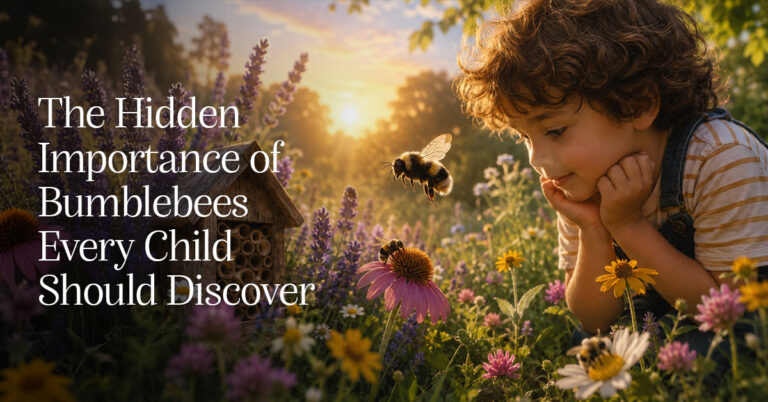
Ask a group of young children what they know about bees, and the answers will probably sound familiar. Some will mention honey. Others might talk about buzzing sounds or yellow and black stripes. A few may even admit they are afraid of getting stung. Very few, however, realise that these tiny insects quietly help produce many of the flowers, fruits, and vegetables found in gardens, parks, and kitchens every day.
Helping children understand the value of bees does not require complicated science lessons. Curiosity often begins with a simple story. A relatable character can turn unfamiliar ideas into something exciting, giving young minds a reason to look a little closer the next time they spot a bee moving from one flower to another.
Picture books offer a wonderful introduction to the natural world because they encourage children to learn through imagination. Facts become easier to understand when they are connected to characters children enjoy spending time with. Instead of feeling like a lesson, learning becomes part of an enjoyable reading experience.
Kellan Lamberti’s Bixbee’s First Adventure follows that approach beautifully. Bixbee, a cheerful young bumblebee, sets out on his very first nectar-collecting trip, excited to help his colony. Along the way, readers discover that collecting nectar is only one part of a bee’s daily work. Every flower Bixbee visits also benefits from pollination, allowing many plants to continue growing and producing fruit. Scientific ideas are introduced naturally, making them easy for younger audiences to understand without interrupting the adventure.
Children often become interested in nature after forming an emotional connection with an animal or insect. A youngster who enjoys reading about a friendly bumblebee is far more likely to notice bees while playing outside or walking through a garden. Curiosity grows because the experience feels personal instead of academic.
Simple moments outdoors suddenly become opportunities for discovery. A child may stop to watch a bee disappear into a flower or wonder where it will fly next. Questions begin to appear naturally. What is the bee collecting? How does it find its way home? Why are flowers important? Those conversations help families explore science together without relying on textbooks or formal lessons.
Parents frequently look for activities that encourage children to spend less time looking at screens and more time exploring the world around them. Nature offers endless opportunities for learning, though children often need a gentle introduction before they begin paying attention to the details surrounding them. Stories can provide that first spark of interest.
Reading about bees may inspire a family to plant flowers that attract pollinators, visit a botanical garden, or simply spend a little longer observing insects during an afternoon walk. Small experiences like these help children develop respect for living things while encouraging patience and observation.
Educators recognise the value of connecting literature with real-world experiences. Reading a story about bees can easily lead to drawing activities, classroom discussions, gardening projects, or simple science observations. Children enjoy seeing how ideas introduced in books relate to the environment around them, making learning feel active and enjoyable.
One of the strengths of Bixbee’s First Adventure lies in its ability to combine entertainment with genuine educational value. Readers encounter words such as nectar, pollen, cross-pollination, pheromones, and proboscis within the story before finding clear explanations in a child-friendly glossary. New vocabulary becomes easier to remember because every term connects directly to Bixbee’s experiences.
Early childhood represents an ideal time to introduce environmental awareness. Young children are naturally curious, eager to ask questions, and excited by new discoveries. Positive experiences during those years often influence lifelong attitudes toward wildlife and conservation. Learning to appreciate bees today may encourage greater respect for nature in the future.
Kellan Lamberti has expressed a desire to place Bixbee’s First Adventure into the hands of preschool teachers, elementary educators, librarians, parents, and grandparents who want children to enjoy an engaging story while discovering valuable lessons about friendship, bravery, community, and the natural world. The book was written primarily for children between the ages of three and seven, making it especially well suited for shared reading at home or in early learning environments.
Children do not need to memorise scientific terms to begin appreciating the environment. Learning often starts with something much simpler. A favourite character can inspire curiosity. Curiosity encourages observation. Observation leads to questions, and questions become the beginning of knowledge.
Books introducing nature in an approachable way help children understand that every living creature has an important purpose. Bees may be small, though their daily work supports countless plants that people and wildlife depend upon. Recognising those connections encourages appreciation instead of fear, replacing uncertainty with understanding.
Long after a picture book has been returned to the shelf, its influence often continues in unexpected ways. A child who once hurried past a flower may stop to watch a bee collecting nectar. Another may proudly explain pollination to a family member after recognising the word in the story. Moments like those remind us that meaningful learning does not always begin inside a classroom. Sometimes it begins with a cheerful little bumblebee, a good book, and a child willing to ask one more question.